Honestly, if you ask five different people what AI actually means, you'll get five different answers, and most of them won't even be wrong; the term's just used pretty loosely at this point. Strip away the buzzwords, and it comes down to this: artificial intelligence is machines doing stuff we'd normally expect only a human to do-reading between the lines of a sentence, noticing a pattern, and making a call on something. Machine learning is what's actually driving most of that behind the scenes. Nobody's manually writing out rules for every situation anymore. You just feed the system a large amount of data, and it figures out the patterns on its own—the more examples it sees, the better it gets.
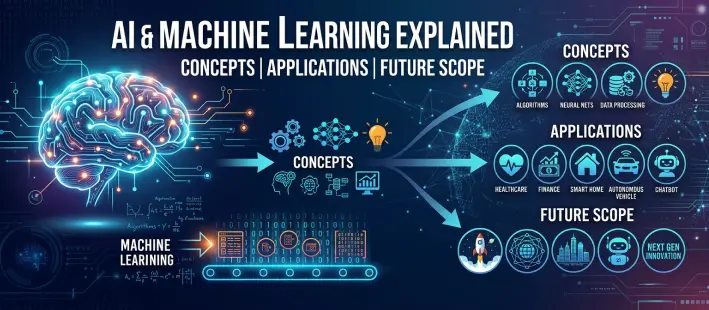
The Relationship Between AI and Machine Learning
AI actually covers a lot more ground than most people realize
Picture AI as the umbrella term covering everything in this space; machine learning sits under it, sure, but so do older rule-based systems and robotics, plenty of which never touch a dataset at all.
Machine learning is one branch, not the whole tree
ML is just one branch under that umbrella. It happens to be the branch that's carried almost all the progress everyone's been talking about over the last decade.
No rulebook; the system just learns as it goes
There's no fixed rulebook to follow here—you just feed the system a bunch of labeled or unlabeled examples, and over time it works out on its own what separates one outcome from another.
Turning what it's learned into real predictions
Once training's done, the model takes whatever it picked up and applies it to brand new data — flagging a transaction that looks off or guessing what you'll click on next.
How Do AI and Machine Learning Work?
Data collection
Nothing happens without data first—it could be numbers in a spreadsheet, medical scans, or customer purchase history, whatever fits the problem you're solving.
Data preparation
Real data is rarely clean. Duplicates, missing fields, inconsistent labels -this stage is unglamorous, but it's where most of the actual work happens.
Model training
This is basically the algorithm going through the same data again and again, tweaking itself a little bit each time, until it starts actually catching onto the patterns that matter instead of just guessing.
Pattern recognition
Somewhere in this process, the model starts working out which inputs genuinely affect the result and which ones are just noise it can safely ignore. Nobody tells it this directly; it figures it out from the training.
Prediction and evaluation
Before anyone actually trusts this thing with real decisions, it gets thrown at data it's never seen before, and you check how close its answers actually are. If it's way off, it goes back for more training.
Types of Machine Learning
Supervised Learning
Every training example comes with a known answer attached. Feed the model thousands of labeled spam and non-spam emails, and eventually it learns to tell them apart on its own.
Unsupervised Learning
No labels this time. The model just goes looking for structure by itself, which is how you get things like automatic customer grouping without anyone predefining the groups.
Reinforcement Learning
The system learns through consequences: try something, get rewarded or penalized,and adjust. Reinforcement learning is the backbone behind a lot of robotics and game-playing systems.
Key Applications of AI and Machine Learning
- Healthcare: Catching things in scans that even an experienced eye might miss, flagging at-risk patients earlier
- Banking and Finance: Spotting fraudulent activity as it happens, running credit checks in seconds instead of days
- E-commerce: Product suggestions built from actual buying patterns, not guesswork
- Education: Courses that adjust pace and difficulty based on how a student is actually doing
- Manufacturing: Predicting equipment failure before it can halt a production line
- Transportation: Smarter routing and the groundwork behind self-driving technology
- Cybersecurity: Picking up on unusual network behavior faster than a human analyst ever could
AI Technology in Everyday Life
Most people interact with this daily without thinking twice:
- Virtual assistants and chatbots: Alexa, Siri, and support bots that resolve issues without needing human help done the process
- Recommendation systems: It's the reason you end up watching three more episodes than you'd planned to
- Maps and navigation: Traffic prediction that reroutes you before the jam even forms
- Face recognition: Unlocking your phone, sorting your photo gallery automatically
- Spam and fraud detection: Quietly keeping your inbox and bank account usable
Benefits of Artificial Intelligence and Machine Learning
- Takes over repetitive work nobody enjoys doing by hand
- Processes data volumes no human team could realistically keep up with
- Cuts decision time from days down to seconds
- Enables a level of personalization that manual work simply can't match
Challenges of AI and Machine Learning
None of this comes free of problems:
- Data privacy: Training data is often personal, and that raises real questions
- Bias in AI models: A model trained on skewed data will make skewed decisions, often without anyone noticing right away
- Data quality: A model is only as reliable as what it's trained on
- Security concerns: The systems themselves can be manipulated or attacked
- Responsible use of AI: Accountability gets murky when an automated decision causes harm
These skills are Required to Learn AI and Machine Learning
- Python programming: The nearly everything in this field is built around the language
- Mathematics and statistics: You don't need to be a mathematician, but probability and basic linear algebra come up constantly
- Data handling: Being comfortable cleaning and working with messy, real-world datasets
- Machine learning fundamentals: Actually understanding what's happening inside the models, not just calling library functions
- Problem-solving: Knowing which approach fits which problem instead of forcing one technique everywhere
- Practical projects: Theory alone doesn't stick; building something is what makes it click
Career Opportunities in AI and Machine Learning
- AI Engineer
- Machine Learning Engineer
- Data Scientist
- NLP Engineer
- Computer Vision Engineer
Demand for these roles keeps climbing, and companies are increasingly looking past resumes toward people who can actually show a working project.
Future Scope of Artificial Intelligence and Machine Learning
- Generative AI: Tools that write, design, and code alongside people, changing how work gets done rather than just automating it
- Intelligent automation: More and more, routine work is running itself with barely any human checking in on it
- Human-AI collaboration: It's not really about AI replacing people — it's more that AI takes the repetitive stuff off your plate so you can focus on the parts that actually need judgment
- AI-powered business solutions: Pretty much every industry's finding its own angle on this now, not just tech companies anymore
- Responsible AI development: Regulation's still playing catch-up, honestly, and probably will be for a while given how fast this is moving
- Growing AI career opportunities: This is one of the rare corners of tech that's still expanding instead of leveling off
Why Learn AI and Machine Learning in Chennai?
Chennai's job market has been absorbing AI-related roles quickly, and it's not limited to the big product-based companies anymore — mid-sized firms and startups are hiring for it too.
- Growing demand for AI skills, spreading well beyond companies that call themselves "tech-first"
- Practical and project-based learning tends to matter more here than sitting through pure theory
- Career opportunities across technology industries, from fintech to healthtech to logistics
Kickstart Your Career in AI and Machine Learning
Here's the thing nobody tells you upfront: this field doesn't reward people who've simply read a lot about artificial intelligence and machine learning. It rewards the ones who sat down, got their hands dirty, and actually shipped something — even if it's small and rough around the edges. So start there. Pick up Python, get comfortable with the fundamentals of AI technology, and finish one project instead of starting five and abandoning all of them halfway.
If you'd rather not spend months figuring out the learning order on your own, AiiTE Academy's Artificial Intelligence course in chennai takes care of that for you. With a clear syllabus built around real applications of artificial intelligence and machine learning, hands-on projects to show for your effort, and expert mentorship along the way, it's a much shorter road to being genuinely job-ready. Take the first step toward a career in AI and machine learning — join AiiTE Academy today.
Frequently Asked Questions
Face ID unlocking your phone is a good example of AI in action. Machine learning is simply the method behind it — the system studies examples and works out the pattern on its own, instead of following rules someone typed in.
Not quite the same. AI is the broad goal of machines behaving intelligently; ML is currently the best method we've found for getting there.
It falls under it. AI is the parent field, and ML is the branch behind almost every recent AI breakthrough.
Yes, no CS degree required. Most people starting today began with just Python and built from zero.
You could try another language, but almost nobody does. The tools, tutorials, and job listings all assume Python.