Innovations in artificial intelligence keep changing the way businesses operate. This makes it one of the most desired jobs in the current job market. Every industry from the health to the financial sector is utilizing AI to make operations more efficient and to offer better services to customers. As a result, companies seek candidates who have experience with AI technology.
If your aim is to have an artificial intelligence career, then you should know which skills are highly valued in companies. It would also be helpful for you to opt for the correct artificial intelligence course in Chennai to get industry-relevant experience.
Industries hiring artificial intelligence professionals in 2026
There is a high demand for AI experts in different fields like:
- Healthcare
- Banking and Finance
- Retail and e-commerce
- Manufacturing
- Education
- Logistics and Supply Chain Management
- Cybersecurity
- Automotive
- Agriculture
As more and more organizations adopt AI technology, there will be diverse job opportunities for skilled professionals.
Top artificial intelligence skills companies want in 2026
Python Programming
This is the most popular language used for writing programs related to artificial intelligence because of the language’s ease of use and flexibility.
Skills employers expect:
- Fundamental concepts of Python and OOPS
- Various data structures and algorithms
- Numpy, Pandas, Scikit-learn
- TensorFlow or PyTorch
Why this skill matters:
- Builds machine learning and AI modeling
- For data manipulation and analysis
- Automation tasks
- Application of scalable artificial intelligence solutions
Machine Learning
Using machine learning, AI applications can learn from data and build predictions based on the data as opposed to following specific rules.
Skills employers expect:
- Supervised and unsupervised learning knowledge
- Regression and classification knowledge
- Model training and testing
- Feature engineering
Why this skill matters:
- Predictive model creation
- Business problem solving
- Making data-driven decisions
Deep Learning
Deep Learning is an approach that is used for complex AI solution creation using neural networks for understanding complex data.
Skills employers expect:
- Neural Networks
- Convolutional and recurrent neural network
- Tensorflow and Pytorch
- Model optimization
Why this skill matters:
- Image and voice recognition
- Precision of AI solutions
- Building intelligent applications
Generative AI
Generative AI helps to create content, optimize workflow, and increase company productivity using the advanced AI technologies.
Skills employers expect:
- Large Language Models (LLM)
- Prompting
- AI Content Generation
Why this skill matters:
- Automation of content creation
- Increased efficiency of business
- Advanced uses of AI
Prompt Engineering
Prompt engineering focuses on creating effective prompts in order to receive a proper response from the AI.
Skills employers expect:
- Prompt writing ability
- Context management
- Evaluation of the AI's response
- Optimization of the prompts
Why this skill matters:
- Increased accuracy of AI-generated results
- Reduced number of errors
- Increased efficiency of AI usage
Natural Language Processing (NLP)
NLP allows computers to do natural language processing by understanding, interpreting and generating human language.
Skills employers expect:
- Processing of text
- Sentiment analysis
- Chatbot development
- Language modeling
Why this skill matters:
- Powers chatbots and virtual assistants
- Improve customer experience
- Supports language-based AI solutions
Computer Vision
Computer vision technology assists AI systems to visualize, understand and interpret images and video streams.
Skills employers expect:
- Image Processing
- Object Detection
- Image Classification
- OpenCV basics
Why this skill matters:
- Medical imaging applications
- Quality inspection
- Enables visual AI applications
AI Model Deployment
Deployment of AI models makes sure they are deployed in practical applications effectively.
Skills employers expect:
- Basics of model deployment
- Basics of API integration
- Cloud deployment
- Model monitoring
Why this skill matters:
- Makes AI solutions production-ready
- Improve performance of applications
- Supports scalable deployment
Cloud AI Platforms
The cloud computing platform provides the infrastructure where AI applications can be developed, trained and implemented.
Skills employers expect:
- AWS, Azure, Google Cloud
- Cloud Storage
- AI services
- Deployment services
Why this skill matters:
- Allows developing scalable AI programs
- Makes collaboration easier
- Lowers the cost of the infrastructure
Data Analysis & Visualization
Data analysis and visualization is crucial in creating highly efficient AI applications.
Skills employers expect:
- Data cleaning
- Data visualization
- SQL fundamentals
- Power BI/Tableau
Why this skill matters:
- Improves quality of data
- Better interpretation
- Better performance of models
AI Ethics and Responsible AI
Responsible AI concerns developing a fair, transparent and safe AI technology.
Skills employers expect:
- AI ethics principles
- Data privacy
- Bias detection
- Responsible AI
Why this skill matters:
- Builds credible A
- Ensures ethical conduct
- Aids regulatory compliance
Emerging artificial intelligence job roles in 2026
Some of the most in-demand job roles in the field of artificial intelligence are:
- Artificial Intelligence Engineer
- Machine Learning Engineer
- Data Scientist
- Generative AI Developer
- Computer Vision Engineer
- Natural Language Processing Engineer
- Artificial Intelligence Research Engineer
- AI Consultant
The role of an artificial intelligence engineer continues to evolve due to the growing use of technology by companies. The future is bright for those individuals who keep themselves updated with new developments.
How to build these artificial intelligence skills
For the development of strong artificial intelligence skills, a combination of systematic study and practical knowledge is needed. One should start with grasping the basics of programming and mathematics before moving on to the techniques of machine learning and deep learning.
Work on projects that involve problem solving, participate in coding challenges, build your portfolio, take up open-source projects, and always learn something new in the area of artificial intelligence. These activities not only strengthen technical expertise but also demonstrate your capabilities to potential employers.
Future trends that will shape artificial intelligence careers after 2026
Some of the key trends for the future of AI careers could be as follows:
- AI agents for doing complex tasks with minimal human interference
- Multimodal AI for analysis of text, image, sound, and video data at the same time
- Responsible AI for improving the ethics and transparency of development
- Cloud-based AI solutions to assist in building applications using AI
- Edge AI for quick processing through edge computing devices
- Robotics and intelligent automation for better efficiencies across industries
People who constantly update their artificial intelligence skills would be able to meet the requirements of the industry in the future.
Why 2026 is the right time to build an AI career
In 2026, many professionals are choosing artificial intelligence careers. The use of innovative artificial intelligence solutions is being explored by many firms all around the world, providing career opportunities to specialists in diverse fields of specialization.
The demand for AI specialists is growing not only among startups and international firms but also among research and governmental organizations. AI careers provide great opportunities and promising salary prospects, and joining the profession today is bound to give you an edge in the future.
Transform your AI learning into career opportunities
AI is changing the face of industries and opening up wonderful career prospects for those who are willing to adapt themselves and learn. By 2026, the employers will seek candidates who can offer technical knowledge along with project expertise, analytical thinking and continuous learning.
AiiTE, the best IT training academy in Chennai, provides industry-oriented training that can make you job ready. Our artificial intelligence course in Chennai provides you training, practical project exposure and placement support that can help you to shine in the competitive world of technology.
Kickstart your AI journey with AiiTE and gain the confidence to excel in today's competitive job market.
Frequently Asked Questions
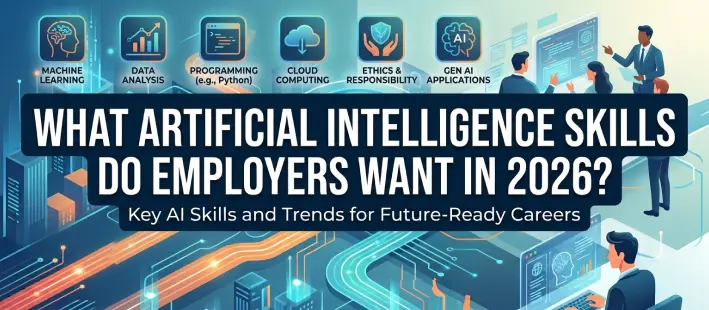
The employer will typically look for candidates who have knowledge in Python, machine learning, deep learning, data analysis, cloud computing, prompt engineering, NLP, computer vision, and ethical AI.
Yes. Python is often referred to as the most popular programming language in the domain of artificial intelligence as it offers powerful libraries and frameworks.
Industries are hiring AI professionals including health care, finance, retail business, manufacturing industries, education sectors, cybersecurity firms, logistic companies, automotive industries, farming, and e-commerce.
While a certificate may indicate that the person has theoretical knowledge about the subject, practical skills are more valuable to the employer as they show their capabilities.
Yes. Fresh graduates are perfectly capable of working in AI if they have the right technical background, experience in projects and interest to learn.