Your phone unlocks the moment it sees your face. A streaming app suggests a series you end up binge-watching. Your inbox quietly hides spam before you ever notice it. Behind all of this, people throw around words like "AI," “machine learning," and “deep learning” as if they mean the same thing.
They don’t, and mixing them up is one of the most common stumbling blocks for newcomers. People often lump AI/ML deep learning together as a single buzzword, which makes the whole field feel more confusing than it really is.
This guide clears that up in plain language. Think of it as AI for beginners without the heavy jargon. By the end, you will know how the three ideas connect, where each one shows up in daily life, and how to take your first learning steps.
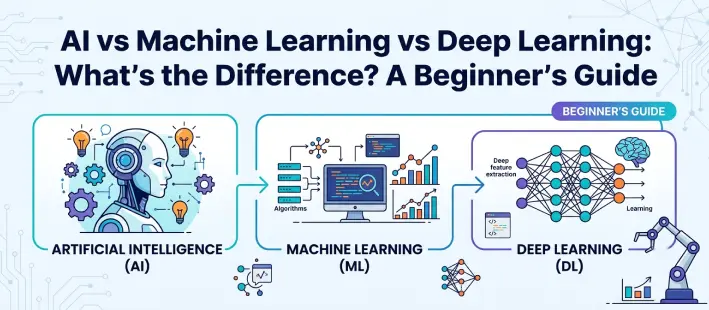
How AI, Machine Learning and Deep Learning Are Connected
Picture three circles, one inside the other. The biggest circle is artificial intelligence. Inside it sits machine learning. Inside machine learning sits deep learning.
So every deep learning system is also machine learning, and every machine learning system is also AI. But it does not work the other way around. Plenty of AI has nothing to do with learning from data. Keep this picture in mind, and the rest of the article will feel easy.
What Is Artificial Intelligence (AI)? Meaning and Examples
Artificial intelligence is the broad goal of making computers do things that normally need human thinking. That includes understanding speech, recognizing faces, making decisions, translating languages, and solving problems.
The idea is older than most people think. Researchers started using the term back in the 1950s. Early AI was mostly rule-based. A programmer wrote thousands of “if this, then that” instructions, and the computer followed them exactly.
Rule-based systems work well when the situation is narrow and predictable. They struggle when the real world gets messy, because nobody can write a rule for every possibility. That limitation pushed researchers towards a smarter approach.
What Is Machine Learning? How Computers Learn from Data
Machine learning flips the old method around. Instead of giving the computer rules, you give it examples and let it work out the rules on its own.
Think about how you learned to spot a ripe mango. Nobody handed you a formula. You saw many mangoes, noticed the color, smell, and softness, and slowly your judgment improved. A machine learning model does something similar with data.
Writing a rule for every trick a thief might try is impossible, so the team does something different. They show the model lakhs of past transactions, each already marked as genuine or fraudulent. Slowly, the model picks up the signs: odd hours, a sudden huge amount, the same card used in two cities within ten minutes. The next time a payment looks like that, it gets flagged for a person to check.
Most machine learning falls into three styles:
- Supervised learning: The data comes with the answers attached, just like the fraud example. The model makes a guess, compares it with the correct label, and improves.
- Unsupervised learning: The model hunts for natural groups on its own. A retailer might discover that its customers fall into four very different buying habits without anyone telling the system what to look for.
- Reinforcement learning: This one is trial and error. The program earns a reward for a good move and a penalty for a bad one, and it plays a game thousands of times until it gets good at it.
Just getting started? Machine learning for beginners is usually easiest through supervised learning, because you can clearly see what went in and what came out.
What Is Deep Learning? Neural Networks Made Simple
Deep learning is a special branch of machine learning built on artificial neural networks. These networks are loosely inspired by the way brain cells pass signals to each other. They are made of many layers, and the word “deep” simply refers to how many layers there are.
Each layer picks up something a little more complex than the one before. When a deep learning model looks like a photo of a car, the early layers are known as edges and shades. The middle layers spot shapes like ears and eyes. The final layers put it together and said, "That's a dog.”
The best part is that the model finds these features by itself. In traditional machine learning, a human often has to decide which features matter. Deep learning removes much of that manual work.
The price is hunger for resources. Deep learning usually needs huge amounts of data and powerful hardware such as GPUs.
AI vs ML vs Deep Learning: Key Differences at a Glance
Anyone searching for AI vs. ML vs. deep learning is really asking about scope, method, and effort. This table puts it side by side.
| AI | Machine learning | Deep learning | |
|---|---|---|---|
| Scope | The broadest goal | A way to achieve AI | A technique within machine learning |
| How it works | Rules or learning | Learns patterns from data | Learns through layered neural networks |
| Data needed | Can be very little | Moderate | Very large |
| Human effort | Writes rules | Often picks features | Finds features on its own |
| Example | A rule-based chatbot | Spam filter | Face unlock, voice assistants |
A common question is artificial intelligence vs. machine learning: which one is “better”? That is like asking whether transport is better than cars. One is the wider goal; the other is a way of reaching it.
Real-Life Examples of AI, ML and Deep Learning You Use Daily
You use all three every day, usually without noticing.
AI in general: A navigation app that finds the quickest route or a customer support bot that answers common questions.
Machine learning: Recommendations of a product on the shopping site, predicted delivery times, and the filters that sort your email.
Deep learning: Voice assistants that understand your accent, apps that translate a sign through your camera, and tools that write text or generate images.
5 Common Myths About AI and Machine Learning, Busted
- “AI will think like a human.” Today’s systems are very good at narrow tasks and poor at general common sense. A model that beats a champion at a board game cannot book you a train ticket.
- “You need to be a math genius.” Maths helps, but you can start with practical projects and pick up concepts as you go. Many working professionals began exactly this way.
- “More data always means better results.” Quality matters as much as quantity. A model trained on messy or biased data will repeat those problems.
- “Deep learning is always the best choice.” Not at all. For small datasets or simple problems, a basic machine learning model is often faster, cheaper, and easier to explain.
How to Start Learning AI and Machine Learning
You do not have to master everything at once. A sensible order looks like this:
- Learn Python: It is the most widely used language in this field, and it reads almost like English.
- Brush up on basics: Some statistics, a little algebra, and a feel for probability are enough to begin.
- Try small machine learning projects: Predict house prices or classify flowers using public datasets.
- Build a portfolio: Two or three finished projects say more than a long list of certificates.
Start Your AI Learning Journey Today
AI is the big goal, machine learning is the way computers learn from data, and deep learning is a powerful, layered form of machine learning. Once you see them as nested circles, the confusion fades and the field starts to feel approachable.
If you would like guided practice, expert mentors, and real projects, an artificial intelligence course in Chennai can give you that structure. AIITE Academy offers hands-on training that takes learners from the basics to job-ready skills, so you can turn curiosity into a career. Start small, stay curious, and build something this week.