
Every app on your phone depends on a team that ships updates fast without breaking things. Food delivery, banking, streaming, and online shopping all work this way. Behind that speed sits a group of specialists who connect software development with IT operations.
Their work rarely gets applause. When it goes well, nobody notices. Releases roll out smoothly, servers stay up, and customers stay happy.
If you keep seeing the word "DevOps" on job boards and wonder whether it fits your career plans, this guide is for you. We will cover the daily work, the tools, the abilities, and the learning path in plain language. At the end of the process, you know exactly what the process.
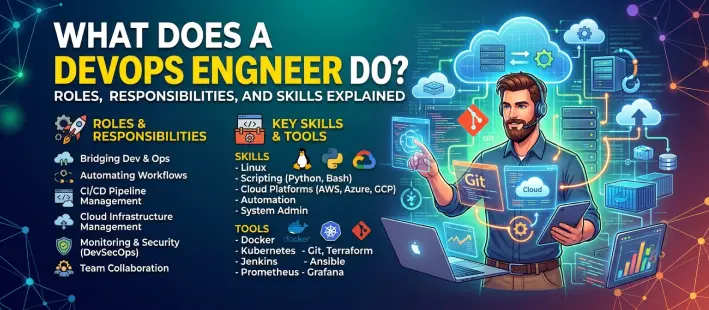
What Is a DevOps Engineer?
DevOps is a culture and a set of practices. It combines developers and operations teams to build software.
A professional in this field acts as the bridge between those two worlds. They automate the journey of code from a developer's laptop to a live server. Then they keep that system healthy.
Think of a city's road network. Someone designs the highways, sets up the traffic signals, and schedules the repairs. In the same way, a DevOps practitioner designs the pipelines, sets up the checks, and keeps everything running. Code travels fast, and it travels safely.
Why Companies Need DevOps Engineers
Years ago, developers wrote code and passed it to the operations team. Operations then tried to run it. Problems showed up late, and teams blamed each other. Releases happened a few times a year, and every release felt risky.
Today the pace is completely unique. Many companies release updates every week, and some release many times a day. This approach only works with automation and shared ownership.
The benefits are easy to see:
- Faster delivery of new features
- Fewer failures after release
- Quick recovery when something does break
- Lower costs through better use of cloud resources
From IT services firms to fast-growing startups and banks, almost every business that runs on software needs this kind of expertise.
DevOps Engineer Roles and Responsibilities
What does a DevOps engineer do all day? No two days look the same, but most of the work falls into a few clear groups.
Building and Maintaining CI/CD Pipelines
Continuous integration and continuous delivery (CI/CD) sit at the center of this work. Each time a developer pushes new code, an automated pipeline builds it, runs the tests, and gets it ready to ship. Jenkins, GitHub Actions, and GitLab CI are common choices. The real value is speed: a bug caught here costs minutes, while the same bug in production can cost a whole weekend.
Managing Infrastructure as Code
Nobody wants to click through a cloud console fifty times to set up one environment. So teams describe their servers, networks, and databases in code, using tools like Terraform and Ansible. Since those files live in version control, anyone can review a change, repeat the setup, or roll it back when something goes wrong.
Working with Containers
Docker bundles an app with everything it needs, so it behaves the same on every machine. Kubernetes then looks after those containers for you. If one crashes, it starts a new one, and when traffic jumps, it adds more.
Monitoring and Responding to Incidents
Shipping the software is half the job. Prometheus, Grafana, and the ELK stack show how it behaves once real users arrive. When an alert goes off at 2 a.m., the on-call person finds the cause and fixes it. Afterwards, they write up what happened so the same problem does not come back.
Protecting the System
Security now runs through every stage, an approach often called DevSecOps. In practice, that means scanning code for weak spots, keeping passwords and keys in safe storage, and carefully deciding who gets access to what.
Collaborating and Documenting
The best tools still cannot replace good teamwork. A big part of the day goes into writing clear notes, helping developers with their releases, and sharing what the team learned from the last mistake.
How DevOps Engineer Job Roles Differ Across Companies
The title looks the same on every job post, but the work can vary a lot.
In a small startup, one person may handle pipelines, cloud costs, security, and support. In a large enterprise, the work is split into focused teams. You might see titles such as Site Reliability Engineer, Platform Engineer, Cloud Engineer, or Build and Release Engineer.
So read the job description carefully, not just the title. Look for the tools, the size of the team, and whether on-call duty is expected.
Top DevOps Engineer Skills to Learn First
You do not need to master every tool on the market. What you need is a solid base, and the rest becomes much easier to pick up. Here is where to focus first.
Linux
Most servers in the real world run on it, so you will spend a lot of time in the command line. Get comfortable moving around, editing files, and checking processes.
Scripting
Bash and Python save you from repeating the same task again and again. Even small scripts can free up hours every week.
Git
Every team shares code through version control, so knowing how to branch, merge, and fix conflicts is a daily need.
Networking basics
DNS, HTTP, firewalls, and load balancers come up more often than you would expect. When something breaks, a clear idea of how traffic flows helps you find the cause fast.
Cloud platforms
Pick one, such as AWS, Microsoft Azure, or Google Cloud, and learn it well. The ideas carry over easily to the others.
Automation and Monitoring Tools
These are the tools that do the heavy lifting: CI/CD pipelines, containers, and infrastructure as code, all covered earlier. Add monitoring to the mix, which simply means reading logs and metrics so you can spot trouble early, and you have the backbone of daily work.
Knowing the tools is not enough. Think of the teammate who tells everyone exactly what went wrong, fixes it quietly, and moves on without blaming anyone. That person has real DevOps skills, and they go well beyond commands and configuration files. They explain problems in plain words, stay calm when an alert goes off, and take ownership instead of pointing fingers. Tools can be learned in a few months. These habits take longer to build, which is why employers notice them so quickly.
DevOps Engineer Roadmap for Beginners: Step-by-Step Learning Path
Learning everything at once leads to burnout. Take it one stage at a time. This path also works as a DevOps roadmap for beginners with no prior experience.
Stage 1: Linux and Networking
Start by getting friendly with the terminal. Learn how files, permissions, and processes work, and pick up the basics of IP addresses, ports, and DNS. Nearly everything else you learn will sit on top of this.
Stage 2: Git and Scripting
Start by creating a repository and making a few commits, so the basic flow becomes second nature. Then break something on a separate branch on purpose and fix it. That is where branching and recovery finally make sense. Once you feel comfortable, write small Bash or Python scripts for the chores nobody enjoys, like renaming a batch of files or checking how much disk space is left.
Stage 3: Cloud Fundamentals
Pick one cloud provider and stay with it for now. Launch a server, attach some storage, and set up a simple database to see how the pieces fit together. When you finish experimenting, switch everything off. A server left running in the background can quietly turn into a very large bill.
Stage 4: CI/CD Pipelines
Here the earlier steps start working as one system. Build a pipeline that tests your code and deploys a small app automatically, with no one clicking a button. The first time it runs on its own and works, it feels like a real turning point.
Stage 5: Infrastructure as Code with Terraform
Take the cloud setup you built by hand and recreate it with Terraform. It feels slow at first. But once you can rebuild a whole environment from a few files, you will see why teams depend on it.
Stage 6: Monitoring and Security
Set up dashboards and alerts so you hear about problems before your users do. Then add some basic security habits. Keep secrets out of your code, and give people access only to what they truly need.
Spend three to six weeks on each stage, depending on your pace. Hands-on practice beats passive watching every time.
How to Become a DevOps Engineer: 5 Practical Steps
The roadmap tells you what to learn. These steps show how to turn that learning into a job.
Build real projects
Deploy a small web app from code commit to a live server, fully automated. Put the work on GitHub with a clear README.
Earn a certification or two
Options include AWS Certified Cloud Practitioner, HashiCorp Terraform Associate, and Certified Kubernetes Administrator. They help to prove your knowledge and help your resume get more value.
Start from a nearby role
Many people move into DevOps from system administration, software development, testing, or technical support. You do not have to land the perfect role on day one.
Prepare for interviews
Expect questions on Linux, Git, pipelines, containers, and troubleshooting. Practice explaining your projects out loud
Keep learning
The tools are being updated frequently. So follow the engineering blogs, join the communities, and try to learn new tools in a home lab.
DevOps Career Growth and Job Outlook
As more companies move their systems to the cloud, the need for people who can keep everything running smoothly keeps growing. That demand is a big reason this field feels so promising right now.
The good news is that you will not be stuck in one spot. After a few years of hands-on work, many people step up to senior or lead positions, where they guide projects and mentor newer teammates. Some become architects who plan how entire systems should be built. Others lean toward site reliability, platform engineering, or people management.
What makes this career special is how much ground it covers. You touch code, servers, security, and teamwork all in the same week, so there is always something new to learn and a new direction to explore.
Start Your DevOps Journey
DevOps is about speed, quality, and teamwork. Professionals in this space build the pipelines, run the infrastructure, watch the systems, and help teams deliver better software again and again. The path is clear: learn the foundations, build projects, and grow step by step.
Learning on your own works, but it can feel slow when you are stuck with no one to ask. If you want mentors, live projects, and regular feedback, a DevOps course in Chennai can help you move faster. AiiTE Academy is one option worth looking at, offering guided training where you work through real tools and scenarios alongside instructors who can unblock you quickly. Having that structure means less time lost to trial and error, and more time spent building skills that employers look for.