
You’ve trained your first model. The code runs, the output looks neat, and a number on the screen says 95%. It feels like a win.
But is it really? That 95% could mean your model is brilliant, or it could mean it’s quietly useless. The difference comes down to how you measure it.
If you’ve ever asked yourself what is artificial intelligence and machine learning, the short version is this: machines learn patterns from data and use them to make predictions. But a prediction is only valuable if you can trust it. That’s where model evaluation comes in, and it’s one of the most important skills for anyone working with data.
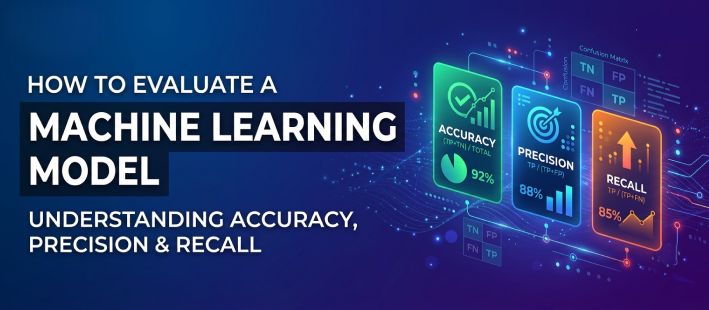
In this guide, we’ll walk through accuracy, precision and recall in plain language, with examples you can picture.
Why Model Evaluation Matters in Machine Learning
A model that performs well on paper can fail badly in the real world. Think about a bank using a model to flag fraud, or a hospital using one to spot early signs of disease. A wrong prediction in these cases costs money, time, or even someone’s health.
Evaluation tells you three things:
- How often your model is right
- What kind of mistakes it makes
- Whether it’s ready to be used on real data
Different problems need different yardsticks. Picking the wrong one is like judging a fish by how well it climbs a tree.
What Is a Confusion Matrix? TP, TN, FP, and FN Explained
Before any formula, you need to understand the confusion matrix. Despite the name, it’s pretty simple. It’s just a table that compares what your model predicted with what actually happened.
For a yes/no problem, there are four possible outcomes:
- True Positive (TP): The model said “yes” and it was yes
- True Negative (TN): The model said “no” and it was no
- False Positive (FP): The model said “yes” but it was actually no. This is a false alarm
- False Negative (FN): The model said “no” but it was actually yes. This is a missed case
Every metric we’re about to discuss is built from these four numbers. Once you’re comfortable with them, the formulas stop feeling scary.
Let’s use one example throughout. Imagine a model that screens 1,000 patients for a particular disease. Only 50 of them truly have it. Here’s how the model performs:
- TP = 40 (sick patients correctly flagged)
- FN = 10 (sick patients the model missed)
- FP = 30 (healthy patients wrongly flagged)
- TN = 920 (healthy patients correctly cleared)
What Is Accuracy in Machine Learning? Formula, Example, and Its Biggest Limitation
Accuracy answers a simple question: out of all predictions, how many were correct?
Accuracy = (TP + TN) / (TP + TN + FP + FN)
For our example: (40 + 920) / 1,000 = 96%.
That looks great. But here’s the catch, and it’s a big one.
Suppose someone builds a lazy model that predicts “healthy” for every single patient. It would be right for 950 people and wrong for 50. That’s 95% accuracy, from a model that never catches a single sick patient.
This is called the class imbalance problem. When one outcome is far more common than the other, accuracy gives you a flattering picture that hides real failure. It works well when your classes are roughly balanced, such as a 50/50 split between cats and dogs. When they’re not, you need better tools.
What Is Precision in Machine Learning? Formula and When to Use It
Precision looks only at the cases where your model said “yes.” Of those, how many were actually yes?
Precision = TP / (TP + FP)
In our example: 40 / (40 + 30) = 40 / 70 = 57.1%.
So when the model flags a patient as sick, it’s right only about 57% of the time. The rest are healthy people who got scared.
Precision matters most when false alarms are expensive. A few real-life cases:
- Email spam filters: If a filter marks your job offer letter as spam, that’s a costly false positive
- Product recommendations: Showing irrelevant items annoys customers and lowers trust
- Legal or compliance screening: Wrongly accusing someone can have serious consequences
A simple way to remember it: precision is about quality. When the model speaks up, can you trust it?
What Is Recall in Machine Learning? Formula and When It Matters Most
Recall flips the question. Out of all the actual positive cases, how many did the model find?
Recall = TP / (TP + FN)
In our example: 40 / (40 + 10) = 40 / 50 = 80%.
The model caught 40 of the 50 sick patients and missed 10. For a medical screening tool, those 10 missed people are the real worry.
Recall matters most when missing a case is costly:
- Disease detection: Missing a sick patient is worse than ordering an extra test
- Fraud detection: One undetected fraud can cost far more than a few false alerts
- Security systems: A missed threat is far more damaging than a false alarm
Think of recall as coverage. Did the model find everything it was supposed to find?
Precision vs Recall: Understanding the Tradeoff
Here’s where it gets interesting. You usually can’t maximise both at once
If you make your model more cautious and only flag cases when it’s very sure, precision goes up, but you’ll miss more real cases, so recall drops. If you make it more sensitive and flag anything suspicious, recall goes up, but you’ll get more false alarms, so precision drops.
It’s a bit like a fishing net. A wide net with small holes catches almost every fish (high recall) but also pulls in a lot of rubbish (low precision). A net with big holes catches only the large fish you want (high precision) but lets many get away (low recall).
The right balance depends entirely on your problem. A cancer screening tool should lean toward recall. A system that automatically blocks bank accounts should lean toward precision.
What Is the F1 Score? Balancing Precision and Recall in One Metric
Sometimes you need a single score that balances both. That’s what the F1 score does. It’s the harmonic mean of precision and recall:
F1 = 2 × (Precision × Recall) / (Precision + Recall)
For our example, that works out to about 66.7%.
The harmonic mean punishes extreme imbalance. If either precision or recall is very low, the F1 score drops sharply. So you can’t hide a weak spot behind a strong one. It’s especially handy when you’re comparing several models on an imbalanced dataset.
Which Evaluation Metric Should You Use? Accuracy vs Precision vs Recall vs F1
There’s no universal winner. Here’s a quick way to decide:
| Situation | Best Metric |
|---|---|
| Balanced classes, equal cost of errors | Accuracy |
| False alarms are costly | Precision |
| Missing a case is costly | Recall |
| Imbalanced data, need a balance | F1 Score |
Before you pick, ask yourself one honest question: which mistake would hurt more, a false alarm or a missed case? Your answer points you to the right metric almost every time.
5 Common Model Evaluation Mistakes Beginners Should Avoid
Even people with some experience slip up here. Watch out for these:
- Trusting accuracy blindly: Always check the class distribution first
- Evaluating training data: A model will always look good on data it has already seen. Use a separate test set, or cross-validation
- Ignoring the business context: A metric is only useful if it reflects what actually matters to the problem
- Reporting one number only: Show the confusion matrix too. It tells the whole story
- Forgetting the threshold: Most classifiers use a probability cutoff, often 0.5. Changing it shifts the balance between precision and recall
Machine Learning Interview Questions on Accuracy, Precision, and Recall
If you’re preparing for a data or AI role, expect these concepts to come up. Questions like “Why is accuracy a poor metric for imbalanced data?” or “When would you prefer recall over precision?” are among the most common machine learning interview questions. Interviewers love them because they reveal whether you understand the why behind a metric, not just the formula. Practise explaining each one with a real-world example, just like we did above.
Choosing the Right Metric for Your Model
Evaluating a model isn’t about chasing the highest number. It’s about understanding what your model gets right, what it gets wrong, and which of those mistakes you can live with. Accuracy gives you the big picture, precision tells you how trustworthy the positive predictions are, and recall shows how much you’re catching. The F1 score pulls them together when you need balance.
If you’re serious about how to learn artificial intelligence, start with fundamentals like these before jumping into complex algorithms. They’ll make every project you build stronger. And if your goal is to figure out how to become an AI engineer, solid evaluation skills are non-negotiable, because companies hire people who can prove their models work, not just build them.
Learning is always easier with structure and hands-on guidance. If you’re looking for an ai and machine learning course in Chennai, choose one that focuses on real projects, not just theory. At AiiTE Academy, learners work through practical case studies and build the kind of job-ready skills employers look for. If you’re comparing options for an artificial intelligence course in Chennai, take the time to explore what AiiTE Academy offers and take your first confident step into the AI world.