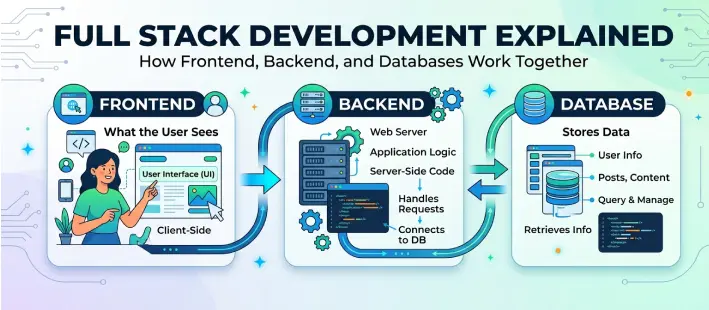
You tap something on your phone. It loads, and your stuff's right where you left it. It feels simple—but that's actually three different systems quietly staying in sync behind the scenes, and almost nobody stops to notice it happening. Essentially, full-stack development involves comprehending how all the distinct components integrate and function cohesively. It's not really one single skill so much as being able to move across every layer of an app and follow how each part hands things off to the next.
What Does "Full Stack" Actually Mean?
The term gets thrown around a lot, and sometimes loosely, but here's the honest version: a full-stack developer can work on the part of the app users see (frontend), the part that handles logic and data behind the scenes (backend), and the database that stores everything permanently. You don't need to be equally brilliant at all three—most full-stack developers lean stronger in one area—but you need to understand how a change in one layer ripples through the others.
What Frontend Development Covers
This covers whatever shows up in the browser—the layout, buttons, animations, and every form field someone types into. HTML, CSS, and JavaScript form the base, and nowadays it's rare to find a web application built without a framework like React, Vue, or Angular sitting on top, mostly because things get messy fast once the app grows past a few pages.
But there's more to it than making the screen look decent. A big part of the job is thinking through the messy edge cases—what happens if someone clicks a button three times before it responds, what the screen should show while data's still loading, and making sure the whole thing feels the same whether it's running on a brand-new laptop or an old phone that's seen better days.
What Backend Development Covers
Users never see this part directly, but everything depends on it. Requests coming in from the frontend land here first; this layer runs the business logic, checks whether someone's even allowed to do what they're asking, and reaches into the database to pull or update whatever's needed. Node.js, Python, Java, and PHP are the usual suspects, typically paired with a framework like Express, Django, or Spring Boot on top.
Say the frontend sends a request along the lines of "Pull up this person's order history. It's this layer that does the actual legwork—confirming who the user is, making sure they've got permission to view that data, grabbing it from the database, and shaping it into something the frontend can actually render on screen.
What Databases Do in the Stack
None of the above matters if there's nowhere to keep the data. Broadly, you're choosing between relational databases like MySQL and PostgreSQL, where everything sits in neat, structured tables, and non-relational ones like MongoDB, which handle messier, less predictable data far more comfortably.
There's no universal "better" option here—it really comes down to what you're actually building. Something like a banking system, where accounts and transactions need strict, well-defined relationships, usually calls for a relational setup. A platform where every piece of content looks structurally different from the next might do better with something more flexible instead.
How Frontend, Backend, and Databases Actually Work Together
Here's the flow, stripped down: you click a button on the frontend, which sends a request to the backend; the backend checks what needs to happen, queries the database if it needs data, and sends a response back that the frontend then displays. All of this typically happens in under a second—across three completely separate systems that don't even need to be written in the same language.
This is really the core of full-stack web development—not knowing every technology under the sun, but understanding this handoff well enough to debug it when something breaks. And something will eventually break; figuring out which layer is actually responsible is half the job.
Core Skills You Need for Full-Stack Development
HTML, CSS, and JavaScript
HTML, CSS, and JavaScript are the non-negotiable starting point for the frontend.
Frontend framework
For a frontend framework, React is the most in-demand right now, though Vue and Angular both have solid footholds.
Backend language and framework
For backend, Node.js with Express is common, but Python with Django is just as valid a path.
Database fundamentals
You'll also need database fundamentals—writing queries, understanding relationships, and knowing when to normalize data and when not to bother.
APIs
You need to understand APIs—specifically REST and increasingly GraphQL—since this is essentially how the frontend and backend communicate with each other.
Version control
Version control matters too—Git isn't optional at this point; every real team uses it.
Basic deployment knowledge
Basic deployment knowledge matters as well—getting your app onto a live server, even a simple one, teaches you things tutorials never will.
Common Tools in a Full Stack Developer's Workflow
Code editors
For code editors, VS Code is the default for most people at this point.
Package managers
For package managers, NPM or Yarn are standard for JavaScript projects.
API testing tools
For API testing, Postman or similar tools let you check backend endpoints without needing a frontend built yet.
Cloud platforms
For cloud platforms, AWS is common, or simpler options like Render and Vercel work well for smaller projects.
Containerization
For containerization, Docker is useful once you're working on anything that needs to run the same way across different machines.
Why Full-Stack Developers Are in Demand
Smaller teams and startups especially can't always afford separate frontend and backend specialists for every project. A developer who understands both ends can move faster, debug issues without waiting on someone else, and generally has a better sense of how the whole system fits together, which tends to make for better architectural decisions even when they're focused on just one part of the stack.
This is a big part of why demand for a full stack developer course in Chennai has grown steadily. Companies here, from product startups to larger IT firms, keep hiring for exactly this kind of versatility rather than narrow specialists.
Where Beginners Usually Go Wrong
- Diving straight into React or Angular before actually being solid with plain JavaScript
- Never really learning how APIs work—then hitting a wall later trying to connect frontend to backend
- Treating databases as something to figure out later instead of learning them properly from the start
- Building things that only ever run on their own laptop, never once pushed live for anyone else to see
- Trying to grab every technology at once instead of just going deep on one stack first
How to Start Learning Full-Stack Development
Pick a single language and commit to it. JavaScript's a solid bet since it covers both sides through Node.js—just stick with it long enough to actually finish something. Don't go chasing ten different frameworks before you've even shipped one working app. Something as basic as a to-do list, but with a real backend and database behind it, will teach you more about how these pieces connect than weeks of scattered tutorials ever will.
Once the fundamentals feel solid, a structured full-stack developer course in Chennai can speed things along from there, especially with the parts that are genuinely hard to pick up on your own, like deployment, working with actual APIs, and structuring a project the way real teams do it.
Take the First Step Into Full-Stack Development
Nobody expects you to know everything on day one. Full-stack development is really just about understanding how each piece of web development talks to the next, well enough to build something that works from start to finish. Pick a stack, build something real, put it online where people can actually use it, and keep going from there.
If you're serious about making a career out of full-stack web development, AiiTE Academy's full stack developer course in Chennai cuts out a lot of the trial and error—helping you learn things in the right order, work on real projects, and build job-ready skills far faster than figuring it all out solo.
Frequently Asked Questions
It means being comfortable working on both what users see and click on and everything running behind that—including the database holding it all together.
Not necessarily together. Plenty of developers start on one side, get solid there, then move to the other—as long as the connection between them eventually makes sense.
JavaScript is a common pick since Node.js lets it cover both ends, though Python paired with Django works just as well.
Six months to a year with consistent effort, though it really depends on how much time gets put in week to week.
For most beginners, it's worth it—it turns what's usually a scattered self-learning mess into something structured, with real projects instead of just theory.