Most beginners don’t quit learning how to code because it’s too hard. They quit because they spent three months doing the wrong things and felt like they were going nowhere. It happens all the time. Someone watches forty hours of videos, builds nothing on their own, and then freezes when a blank editor stares back at them.
Full stack development covers a lot of ground. You deal with the browser, the server, the database, and everything that connects them. That’s exciting, but it also makes it easy to wander off track. Here are the mistakes beginners make most often, and what to do instead.
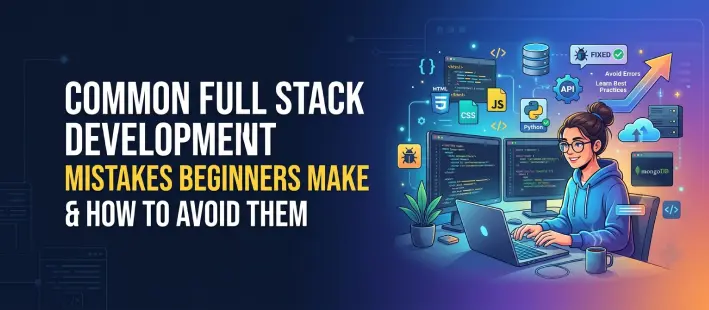
1. Watching Coding Tutorials Without Building Projects
This one catches almost everyone. You follow along, the code works, and you feel like you understand it. Then you try the same thing without the video and nothing comes out.
Watching someone code is not the same as coding. Even a good full-stack web development online course won’t help much if you only press play and nod along.
How to avoid it: Use the 50/50 rule. For every hour of video, spend an hour building something without the video open. Pause often and predict what the next line will be before the instructor types it. When you finish a lesson, rebuild the same feature with different data or a different layout. That’s where the learning happens.
2. Learning React Before Mastering JavaScript Fundamentals
React, Node, and Express look impressive on a job post, so beginners rush toward them. But frameworks are just JavaScript with opinions. If you don’t understand closures, array methods, promises, and async/await, every React error will feel like a mystery.
How to avoid it: Spend a few solid weeks on core JavaScript first. Be comfortable with functions, objects, map, filter, reduce, and how asynchronous code behaves. A quick test: if you can’t fetch data from a public API and display it on a plain HTML page, you’re not ready for a framework yet. That’s not a failure. It’s a clear signal of what to practice next.
3. Trying to Learn Every Web Development Tool at Once
One week it’s React, the next it’s Vue, then Angular, then Python, then Go. Beginners often think more tools means more value. In reality it means shallow knowledge of everything and confidence in nothing.
Pick one stack and stay with it long enough to build several things. The MERN stack (MongoDB, Express, React, Node) is a sensible choice because you use JavaScript across the whole application. If you decide to join a MERN stack course in chennai, check that it makes you build complete projects instead of only covering theory.
How to avoid it: Choose one path for at least six months. Other technologies will be much easier to pick up once you understand how one full stack works from end to end.
4. Ignoring Git and Version Control from Day One
Plenty of beginners save files as project-final, project-final-2, and project-final-REAL. It feels harmless until something breaks and you can’t remember what you changed.
Git isn’t optional. Every team uses it, and recruiters often check GitHub profiles before they call you.
How to avoid it: Start using Git from your very first project. Learn the basics: commit, branch, merge, push, and pull. Write commit messages that describe what changed, not “update” or “fix”. It takes a weekend to get comfortable, and it saves you from countless bad evenings.
5. Not Understanding How the Front End and Back End Communicate
Many beginners can build a nice React interface and a working Express server, but they treat the connection between them like magic. Then a request fails with a CORS error, a 401, or a 500, and they have no idea where to look.
How to avoid it: Learn HTTP properly. Understand what GET, POST, PUT, and DELETE actually do, what status codes mean, and how headers, cookies, and tokens travel between client and server. Use your browser’s Network tab and a tool like Postman to watch real requests. Once you can see the conversation, debugging stops feeling like guesswork.
6. Poor Database Design and Planning in Full Stack Apps
It’s easy to throw data into MongoDB or MySQL without planning anything. It works for a small demo. Then the app grows, queries slow down, and the data structure turns into a mess that’s painful to fix.
How to avoid it: Before you write any code, sketch your data on paper. What are the main entities? How do they relate? Which fields are searched most often? Learn the difference between embedding and referencing in MongoDB, and spend some time with SQL too, because many companies still rely on relational databases. A little planning at the start saves a lot of rewriting later.
7. Skipping Error Handling, Web Security, and Testing
Beginner projects usually assume everything goes right. The user types a valid email, the server responds quickly, and nobody tries anything strange. Real users don’t behave like that.
Storing passwords in plain text, trusting user input, leaving API keys in a public repo, and never validating forms are classic mistakes. They also look bad in a code review.
How to avoid it: Add basic habits to every project. Validate input on both the client and the server. Hash passwords with bcrypt. Keep secrets in environment variables. Use try/catch blocks and return helpful error messages. Write a few simple tests for your most important routes. You don’t need to be a security expert, but you do need to care.
8. Building Only Tutorial Clones and Never Deploying Your App
A to-do app, a weather app, and a Netflix clone are fine for practice. But if your whole portfolio is the same five projects every other beginner has, you’ll blend into the crowd. Another common slip is leaving everything on your laptop, so nobody can actually use what you built.
How to avoid it: Build at least one project that solves a real problem, even a small one. A booking tool for a local tuition center or an expense tracker for your family works well. Then deploy it. Put the front end on Vercel or Netlify, the back end on Render, and the database on MongoDB Atlas. Employers love a live link, and deploying teaches you things no tutorial covers, like environment configs and build errors.
9. Learning in Isolation and Delaying Interview Preparation
Coding in isolation feels comfortable, but it hides your bad habits. Nobody points out that your component is 400 lines long or that your variable names make no sense. Many beginners also finish their projects and only then realize they have no idea how to talk about them in an interview.
How to avoid it: Get feedback early. Join a coding community, find a study partner, or attend structured full-stack developer classes where mentors review your code. Start practicing common full-stack developer interview questions while you’re still building, not after. Questions about the event loop, REST versus GraphQL, state management, and database indexing become much easier when you’ve actually used those ideas. Practice explaining your projects out loud, too. If you can’t explain why you made a choice, you probably don’t fully understand it yet.
Full Stack Developer Roadmap for Beginners: A Step-by-Step Learning Plan
If all of this feels like a lot, here’s a realistic order to follow:
- Learn HTML, CSS, and core JavaScript, and build three small pages
- Learn Git and put everything on GitHub
- Pick up React and build a couple of front-end apps with live APIs
- Learn Node, Express, and a database, then connect them to your front end
- Build and deploy one complete project with login, CRUD, and proper error handling
- Review your code, polish your portfolio, and practice interviews
Nothing here is flashy, and that’s the point. Steady progress beats random sprints every time.
How to Become a Full Stack Developer Without Wasting Time
Every developer you admire made these same mistakes once. The difference is that they kept building, kept asking questions, and fixed their habits along the way. Focus on fundamentals, stick to one stack, write real projects, and get feedback early. That approach will take you much further than any shortcut.
If you want a guided path instead of figuring it out alone, joining a well-structured full-stack developer course in chennai can save you months of trial and error. At AiiTE Academy, the training is built around hands-on projects, mentor feedback, and job-focused preparation, so you learn to build the way companies actually expect. Start small, stay consistent, and you’ll be surprised how quickly things click.